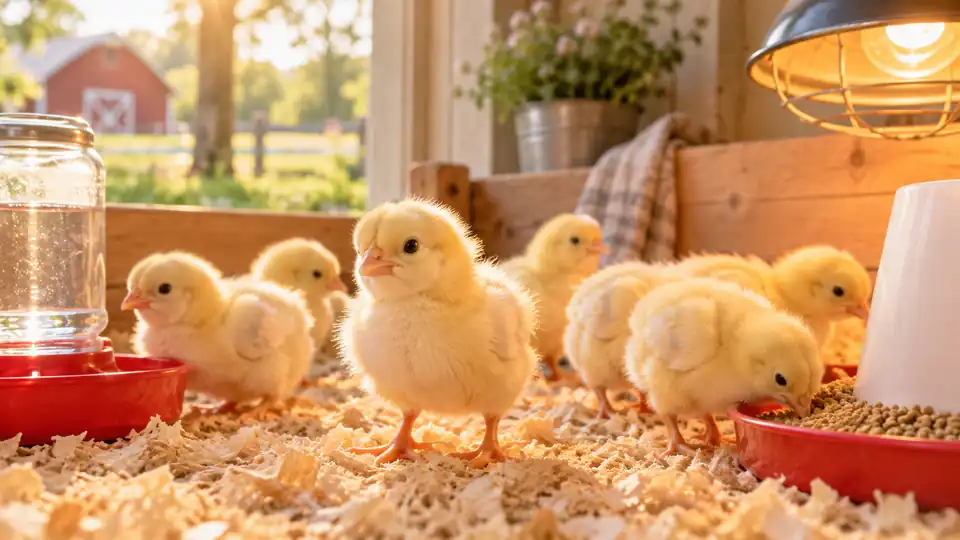
A chick eats a complete chick starter ration from hatch through roughly the first 6–8 weeks, following the feed label and breeder or hatchery guidance. Keep starter feed available throughout the day and provide constant access to fresh, clean water.
Baby chicks grow quickly, so their first feed needs to do more than fill them up. A properly formulated chick starter supplies the protein, energy, vitamins and minerals needed for early growth in one balanced ration. That is why extension programs generally recommend a commercial complete starter rather than a homemade mixture of grains and scraps.
1. What should a baby chick eat? Start with chick starter
Penn State Extension recommends chick starter for the first six weeks, while University of Minnesota and Mississippi State guidance commonly keeps chicks on starter through about six to eight weeks. The exact transition point can vary by product and flock type, so the feed label should be your primary practical guide.
Starter is usually sold as crumbles or mash. Both can work for young chicks as long as the particle size is easy to eat. Large adult-sized pellets are generally not the best first format for newly hatched chicks.
2. How much protein do chicks need?
Starter feeds are higher in protein than later-life rations because chicks are building muscle, feathers and body structure rapidly. Penn State brooding guidance notes that ordinary chicken chicks are commonly fed starter around 18–20% protein, while some meat-bird or specialty starters can be higher.
3. How often should baby chicks eat?
\nIf you are buying feed for several birds, use the Chicken Feed Calculator to estimate daily, weekly and monthly quantities for chicks, growers or adult birds.
For young chicks, feed is generally offered free choice—available whenever they want it. Penn State recommends keeping fresh feed in front of young birds, and small-flock guidance likewise recommends free-choice feeding.
During the first few days, a shallow tray or feeder can make the feed easier to find. Once the chicks are eating confidently, move to a chick-sized feeder that reduces scratching and waste.
4. Water matters just as much as feed
Chicks should have fresh, clean water as soon as they arrive in the brooder. Use a chick-safe waterer that is easy to reach and difficult to climb into. Dirty water can quickly become filled with bedding and feed, so check it several times a day.
If chicks are newly arrived and seem unsure where to drink, gently touching the tip of each beak to the water can help them locate it. Keep the nostrils above the water.
5. Can baby chicks eat vegetables, fruit and treats?
People often ask what else a chick can eat besides starter feed. Small amounts of suitable foods may be introduced as chicks grow, but a complete starter should remain the nutritional foundation. Treats should not replace the balanced ration.
In the early weeks, the complete starter ration should do nearly all the nutritional work. Adding large amounts of scratch grains, seeds, scraps or treats can dilute the nutrient balance of the starter feed.
Mississippi State Extension specifically cautions that mixing other ingredients into a complete feed can upset its nutritional balance. For very young chicks, there is little benefit in rushing into treats.
Foods to avoid giving baby chicks
Avoid using scratch grain, large amounts of kitchen scraps or adult layer feed as a substitute for chick starter. Also discard moldy, spoiled or heavily soiled feed. If you introduce foods beyond complete starter, keep portions small and make sure the food is appropriate for chickens and the chicks' size.
6. Do baby chicks need grit?
If chicks are eating only a properly formulated starter crumble or mash, they can generally digest that feed without additional grit. Once you begin offering other foods or the chicks have access to forage, appropriately sized chick grit becomes more relevant. University of Minnesota recommends chick- or pullet-sized grit at the appropriate age.
Avoid substituting oyster shell or layer calcium products for grit. Those products serve a different purpose and are intended for laying birds, not young chicks.
7. Why chicks should not eat layer feed
Layer ration is designed for hens producing eggs and contains much more calcium than growing chicks need. Penn State brooding guidance specifically warns against feeding layer ration to young birds because the calcium level is inappropriate for growing chicks.
Keep young birds on the ration designed for their growth stage, then transition as they mature according to the feed manufacturer and your flock plan.
8. When do chicks move to grower feed?
Many layer-type chicks transition from starter to a grower or developer ration somewhere around 6–8 weeks. Penn State lists chick starter for roughly 0–6 weeks, while University of Minnesota and Mississippi State commonly describe a transition around 6–8 weeks.
Because commercial formulations differ, use the age range printed on the feed bag. Do not switch to layer ration just because the birds look large; layer feed is for birds that are at or near egg production.
How much does a baby chick eat per day?
There is no single daily amount that fits every chick because intake rises quickly with age and varies with breed, feed and environment. For practical purchasing estimates, enter your flock size in the calculator below rather than treating one number as a feeding prescription.
Use the Chicken Feed Calculator to estimate daily, weekly and 30-day feed quantities based on flock size and life stage.
A simple feeding routine
- Check the feeder each morning and keep chick starter available.
- Remove wet or heavily soiled feed rather than topping over it.
- Refresh drinking water whenever it is dirty.
- Raise or change feeders as chicks grow so they waste less feed.
- Store feed somewhere dry and protected from rodents and moisture.
- Follow the product label for the correct age to transition to the next ration.
Feeding guidance was cross-checked against Penn State Extension, University of Minnesota Extension, and Mississippi State University Extension. Always follow the instructions for the specific feed you purchase.
Baby Chick Care: Your First 7 Days
Put feeding together with brooder warmth, water, bedding and the daily routine for a healthy first week.
Setting up heat? Use the chick brooder temperature chart by age and adjust it using chick behavior.